Thursday, January 16, 2020

Demystifying IGLIDUR

We have earlier looked at Turcite B* and Rulon and explained how they are the result of branding exercises that were set in place at a time when the polymer space was more obscure. In both their cases, we find that even today, older drawings received from OEMs will specify the brand and grade to be used and it usually takes some convincing and possibly development and trials on the part of the OEM to shift to an alternative.
Both Turcite and Rulon, as we illustrated in earlier articles, are PTFE based materials. In some cases, specific pigments have been added to the material to enhance wear properties and offer a visual uniqueness to the grade that other processors might struggle to match. It should be mentioned that especially in the case of Turcite, the distinct turquoise pigment used brings certain synergies with the base PTFE material, causing the wear properties to increase significantly in comparison with other pigments. However, there is no restriction as to who can either procure, compound, or process these pigments with PTFE to ensure the same properties are met by other manufacturers.

What is IGLIDUR?

More recently, as we have ventured further down the path of precision machined components, we have had many OEMs asking us for IGLIDUR material. An initial glance through IGLIDUR’s properties told us that here too, a very significant branding push had been given to re-market generic polymer materials. We also realized that IGLIDUR – manufactured by IGUS in Germany – was priced at several multiples of the cost for a comparable grade bought locally.

While there may no doubt be certain base properties or processing techniques used in the manufacture of IGLIDUR that enhance the properties over a generic substitute, the sheer cost difference makes for a compelling case for OEMs to look beyond the brand and evaluate whether an alternative will suit the application.
Below, we list a few of the most common grades of IGLIDUR. Mapping four key properties, we are able to identify – with some certainty – the generic polymer base for the grade. 


Colour
Specific Gravity
Max Service Temperature (°C)
Tensile Strength (Mpa)
Comparable Material
Iglidur J
Yellow
1.49
120
73
POM / Acetal / Delrin
Iglidur X
Black
1.44
250
170
Carbon PEEK
Iglidur G
Grey
1.46
130
210
PA66 40GF
Igludur P
Black
1.58
130
120
Carbon Filled POM/PA66
Igludur K
Yellow/Beige
1.52
170
80
PES/PESU
For the most part, IGLIDUR grades appear to use either Nylons of Acetal for the base material. In one case – IGLIDUR X, the high service temperature gives away the fact that it must either be PEEK or Polyimide. Similarly, IGLIDUR K, has a high service temperature, but relatively low tensile properties. However, the yellow/beige colour suggests that Polyethersulfone might be the most possible base polymer for this grade.
It should be said that there may certainly be property enhancing additives used in these grades to improve overall performance. However, as mentioned above, any product today can be tested to uncover the true composition of the same. With the composition no longer a mystery, any premium paid would be unjustifiable.
Armed with this knowledge, an OEM can at least begin the process of identifying an alternative. In most of these cases, the grades are easily available from generic stock shape manufacturers. Hence, a proto batch of 20-30 components would be easily developed and can be put under testing without the need for expensive tooling or R&D costs.
Considering the above, there appears a lot of room for exploration for OEMs that are using expensive components because the brand is obscure. IGUS does not easily share the base material used in its products, which might leave many end-users thinking it would be safer to pay the premium and get the right part. However, with the information available today, there is no reason for an OEM to pay many multiples on the cost.

Tuesday, December 17, 2019

PEEK Components and Bearings - Durable, lightweight, and dependable

Developing a new polymer is challenging and needs to take into account what end applications are being catered to. Often, specific polymers will be identified for a certain application, but their limitations would be highlighted. Working off these limitations, a new material can be developed that seeks to fill gaps in performance. Selecting the best material is a critical step in the development of a polymer and this selection process will determine the quality of the final product. Strength, durability, malleability and many other factors are considered when a material is being selected and each of these factors holds a significant importance. 
The development of PEEK, however, was surprising because suddenly, we had one polymer that exhibited properties at the far end of nearly every parameter. Whether we talk of tensile strength, strength-to-weight ratio, wear resistance, machinability or temperature resistance, PEEK truly checks all the boxes and leaves little doubt as to its effectiveness any time a debate on material selection is had.
Suffice to say, that the invention of PEEK revolutionized the plastic component manufacturing industry
PEEK was invented in the UK in 1978 and received a US patent in 1982. The processing conditions implemented to mould the material influence its crystallinity, or structure, and this results in the superb mechanical and chemical resistance properties of PEEK. PEEK is also highly resistant to degradation under high temperatures and resilient in organic and aqueous conditions. These properties make PEEK ideal for a wide array of components in diverse industries. Some of the major fields where this dynamic plastic material has been most effective are aerospace, the medical space, food & beverage and also the manufacture of PEEK plastic bearings.

PEEK in aerospace components

PEEK is optimal in aerospace due to its lightweight properties (it has a specific gravity that is half of aluminium), chemical inertness and toughness. Light-weight materials reduce the overall load of a vessel and, thus, reduce fuel costs and helps preserve the environment. Because PEEK is a chemically inert, the material is stable in extreme conditions and can withstand exposure to atmospheric particles. The fact that PEEK can be machined to the kind of close tolerances needed in aerospace make it an ideal material of choice.

PEEK in medical equipment

In the medical field, hygiene, durability and biocompatibility are all important factors when considering what materials to incorporate. PEEK offers flexible and durable properties and it also has no adverse effects on the skin or internal organs, which makes it an ideal material for implants. Biocompatible grades of PEEK can be used as sensor covers and transducers in medical equipment. Such grades ensure that even in the event of bodily contact, there would no adverse effects. Its resistance to extreme temperatures and low moisture absorption properties also make it a preferred choice for pumping mechanisms.

PEEK in food and beverages

The high-temperature resistance of PEEK makes it a favourable option in the production of powders and other ingredients in the food & beverage industry. PEEK is an effective alternative to PET and holds up well under the extreme temperatures for the drying of ingredients in food as well as feed for animals. The high wear resistance of PEEK also makes it an ideal choice for scrappers, where other polymers would either chip or deform. PEEK valves are also critical in coffee machines, where metallic valves have been known to impart an unfamiliar taste to the beverage. Since the last 5-10 years, high-end coffee machines around the world use PEEK valves in their equipment.

PEEK as a bearing material

One field that has some of the most diverse applications of PEEK is the manufacturing PEEK bearings. PEEK makes an ideal material for bearings for many reasons. PEEK bearings can be made self-lubricating (usually with the addition of PTFE at a concentration of 15-25%). Abrasion causes microscopic bits to function as lubrication with inconsequential alteration to the bearings themselves. The durability and high-temperature resistance of PEEK bearings allows them to be thinner and lighter than traditional material bearings. Their light-weight characteristics make them more fuel-efficient and they don’t require the constant grease and maintenance that metallic bearings demand. As a result, PEEK can reduce bearing production and maintenance costs significantly. PEEK bearings can also run for long periods of time without freezing during operation. The low thermal expansion coefficient of PEEK ensures that it retains dimensional integrity over a very wide range of temperatures – both high and low. The chemical resistance of PEEK bearings allows them to withstand conditions that would otherwise cause damage to metal bearings. All these attributes make PEEK bearings an exceptional mechanical component for an endless number of products and functions
As we can see from these examples, PEEK is effective in a range of industries and PEEK bearings have become a favoured option as a mechanical component. PEEK bearings can be found in many different types of products and even in motors that go into the refrigerators and air conditioners in our homes. PEEK bearings will continue to be implemented in more and more products in the future as well. Keep your eyes open for PEEK plastic materials and PEEK bearings in the machines and products around you.

Demystifying IGLIDUR


We have earlier looked at Turcite B* and Rulon and explained how they are the result of branding exercises that were set in place at a time when the polymer space was more obscure. In both their cases, we find that even today, older drawings received from OEMs will specify the brand and grade to be used and it usually takes some convincing and possibly development and trials on the part of the OEM to shift to an alternative.
Both Turcite and Rulon, as we illustrated in earlier articles, are PTFE based materials. In some cases, specific pigments have been added to the material to enhance wear properties and offer a visual uniqueness to the grade that other processors might struggle to match. It should be mentioned that especially in the case of Turcite, the distinct turquoise pigment used brings certain synergies with the base PTFE material, causing the wear properties to increase significantly in comparison with other pigments. However, there is no restriction as to who can either procure, compound, or process these pigments with PTFE to ensure the same properties are met by other manufacturers.

What is IGLIDUR?

More recently, as we have ventured further down the path of precision machined components, we have had many OEMs asking us for IGLIDUR material. An initial glance through IGLIDUR’s properties told us that here too, a very significant branding push had been given to re-market generic polymer materials. We also realized that IGLIDUR – manufactured by IGUS in Germany – was priced at several multiples of the cost for a comparable grade bought locally.

While there may no doubt be certain base properties or processing techniques used in the manufacture of IGLIDUR that enhance the properties over a generic substitute, the sheer cost difference makes for a compelling case for OEMs to look beyond the brand and evaluate whether an alternative will suit the application.
Below, we list a few of the most common grades of IGLIDUR. Mapping four key properties, we are able to identify – with some certainty – the generic polymer base for the grade. 


Colour
Specific Gravity
Max Service Temperature (°C)
Tensile Strength (Mpa)
Comparable Material
Iglidur J
Yellow
1.49
120
73
POM / Acetal / Delrin
Iglidur X
Black
1.44
250
170
Carbon PEEK
Iglidur G
Grey
1.46
130
210
PA66 40GF
Igludur P
Black
1.58
130
120
Carbon Filled POM/PA66
Igludur K
Yellow/Beige
1.52
170
80
PES/PESU
For the most part, IGLIDUR grades appear to use either Nylons of Acetal for the base material. In one case – IGLIDUR X, the high service temperature gives away the fact that it must either be PEEK or Polyimide. Similarly, IGLIDUR K, has a high service temperature, but relatively low tensile properties. However, the yellow/beige colour suggests that Polyethersulfone might be the most possible base polymer for this grade.
It should be said that there may certainly be property enhancing additives used in these grades to improve overall performance. However, as mentioned above, any product today can be tested to uncover the true composition of the same. With the composition no longer a mystery, any premium paid would be unjustifiable.
Armed with this knowledge, an OEM can at least begin the process of identifying an alternative. In most of these cases, the grades are easily available from generic stock shape manufacturers. Hence, a proto batch of 20-30 components would be easily developed and can be put under testing without the need for expensive tooling or R&D costs.
Considering the above, there appears a lot of room for exploration for OEMs that are using expensive components because the brand is obscure. IGUS does not easily share the base material used in its products, which might leave many end-users thinking it would be safer to pay the premium and get the right part. However, with the information available today, there is no reason for an OEM to pay many multiples on the cost.

Thursday, December 12, 2019

Polymers in Fluid Transfer Applications


The transfer of fluids can be a complicated affair. In most applications that involve fluid transfer, the system is simultaneously subject to one or all of the following conditions:
  1. Pressure
  2. Temperature
  3. Corrosion
Each of these conditions further compounds the effects of the other. For example, while a system may be equipped to handle high pressures, the added effect of corrosion can lead to ruptures or pinholes within the system that can cause failure. Hence, that any system that seeks to contain or transport fluids needs to ensure that all precautions are taken to accommodate the effects and minimise the risk of leakages.
Polymers are the preferred choice for fluid transfer applications for several reasons. First, there exist a huge range of choices that can be compared with the chemical properties of the fluid in question to ensure that the polymer does not react during functioning. A major issue with using metals is that even though they may not necessarily corrode, there is no guarantee that there will not be some reaction with the chemical fluids. Such reactions can alter the properties of the fluids themselves, which would be a problem. Polymers also operate at a wide range of temperatures and given that they are not as hard as metals, they invariably bring sealing properties that metals cannot match.
1. Polymer Seals
Seals can be machined from polymer stock shapes to match the tolerances of any system. Polymer seals are a vast area of application and can include everything from:
  • Ball valve seats
  • Spring-energised seals
  • Sealing rings
  • Chevron V-packings
  • Rotary seals
  • Linear sealing strips
There is no limit to the types of polymers that can be used in a sealing application. PTFE, PEEK, PPS (Ryton) and Polyimide seals are usually preferred in applications where there is a combination of high temperature and corrosive chemicals. In lower temperature applications (say, within 120°C), polymers such as POM (Delrin), PVC or even Polypropylene can be used.
The choice of polymer here is entirely application based. As always, it starts with the chemical compatibility and moves from there. For example, while PEEK is a very robust and machinable polymer, PPS is a preferred option in the paper and pulp industry. This is primarily because even though PEEK is chemically very inert, it does suffer some reaction to the chemicals used specifically in pulp and paper manufacture. With PTFE – which is easily the most chemically inert polymer – the issue is that of deformation. While PTFE can take high pressures – the combination of high pressure and temperatures can cause deformation in PTFE seals over time, leading to leakages.
2. Polymer valves
The function of a valve is to regulate the flow of fluids through a system. Not only does the valve need to ensure that there is a tight sealing around it (fluids should not be able to flow around the valve), but the valve needs to resist the fluids flowing through it and ensure that thermal expansion due to high temperatures does not hinder the smooth movement of the valve.
One application of PTFE valves is in the paints industry. Paint mixing machines use PTFE valves to regulate the flow of liquid paint. PTFE is the material of choice because paints are composed of myriad different chemicals. Each shade of paint would be a result of a specific combination of additives and it is therefore essential to have a material that does not react with what may be potentially thousands of different compounds.
PEEK valves are used extensively in coffee machines. The combination of high temperature liquids and food grade requirements means that PEEK – which is FDA approved – is a key material of choice. PEEK is also very thermally stable, which means that the valve does not expand (and therefore tighten) even when higher temperature liquids are passed through it.
3. PTFE bellows
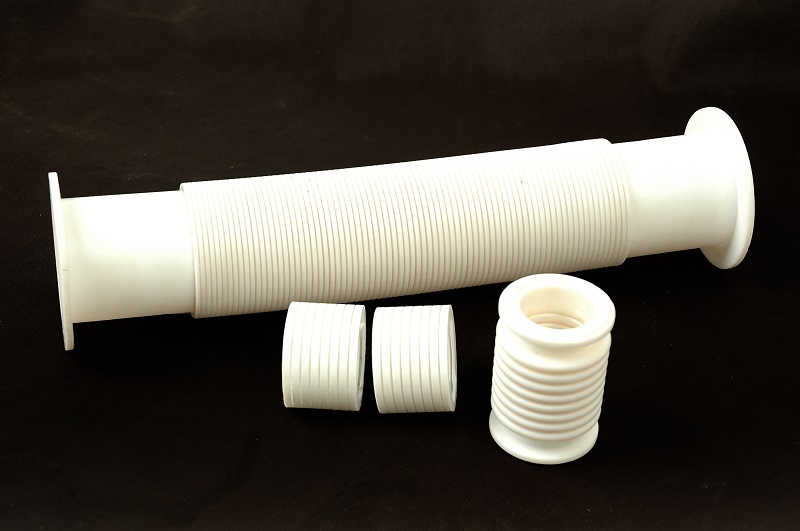
Bellows are complex parts that need to be machined out of PTFE. The key function of a bellow is to accommodate excess pressures and ensure that the system – typically a pumping system – does not fail over a long period of time. PTFE is used primarily because it is soft and because it is chemically inert. The softness of the material allows for the bellow to expand and contract, rather than succumb to higher pressures.

Different bellows have different ratings for the number of cycles that they can accommodate. However, a range of 1-2 million cycles is standard in the industry.
ptfe bellows
The only issue with a PTFE bellow is that because PTFE cannot be injection moulded, the bellow needs to be machined out of a block. This results in a wastage of nearly 80% on the material, making PTFE an expensive choice. Nonetheless, there are applications where nothing other than PTFE will suffice, and hence it is a preferred material in high-end chemical pumps. 
4. ePTFE gaskets
Expanded PTFE, like regular PTFE, comes with a stellar ability to resist chemicals. The only drawback with regular PTFE is that it lacks the elasticity, or seal-ability, of some softer materials such as silicone or Viton rubber. However, these materials still cannot accommodate the high temperatures that PTFE can.
ePTFE arrests some of the issues seen with regular PTFE in that it is highly compressible (up to 65%) and offers an excellent sealing between harder surfaces including metals and glass. More importantly, ePTFE provides sealing in pressures of up to 100Bar, with minimal torque. This means that even more delicate assemblies can be fully sealed without having to put excess pressure on the bolted areas.
Both ePTFE cut gaskets and ePTFE gasket tapes are being increasingly adopted across fluid sealing applications. A combination of its ability to withstand high-temperature and high corrosion while offering high sealing makes it a material of choice.
5. Polymer bobbins
Some fluid sealing systems have a combination of metals and elastomers. For example, airline fluid systems use neoprene rubber for the transfer of fluids. In the event of fire or excess heat, it is essential that these rubber tubes be kept safe and away from metals – which can heat up quickly and melt the rubber easily.
Polymer bobbins are used a medium to shield the rubber from the metals. Metal clamps – rather than being fitted directly on the rubber hose – will clamp around the bobbin which will then come in contact with the hose. This arrangement ensures that the bobbin, which can withstand higher temperatures and will not transfer heat, will keep the neoprene hose safe in the event that the clamp heats up.
6. PTFE (Teflon) Tubes
PTFE tubes are one of the most sought after for fluid transfer. Tubes are resistant to chemicals and high temperatures. At the same time, the wall thickness of a PTFE tube can be enhanced to allow it to accommodate high pressures. Further, with stainless steel braiding, these pressures can be even higher. 
PTFE tubes find application across industries such food processing, chemicals, electrical, and pneumatic lines, to name only a few.
A key example of the application of PTFE tubes is in analyser equipment. The equipment is used to evaluate the chemical composition of gases that reach it though several tubes. Since the gas cannot be allowed change its chemical structure in any way, it is essential that it travels through a medium that will not react with it. PTFE is an ideal medium, as there is no chance that the gas running through it will react with it and this ensures the purity of the system.
The above are but a few examples of polymers and their applications in fluid sealing systems. For the most part, OEMs will design their own systems and then look for polymer solutions that specifically match their application. As such, there are literally thousands of different areas where polymers are used to ensure fluid systems are kept robust and free from leakages.

Monday, June 18, 2018

PTFE (Teflon) Tubing

PTFE Tubes are known for their versatility and durability.
As a material, it comes with the numerous properties of PTFE (Teflon), including temperature resistance, chemical resistance, electrical insulation and high-strength.
The high ratio of strength (both tensile and electrical) to weight gives us the option of using a much smaller tube of PTFE to do the same task that might require a lot more of a less capable material.
A high burst pressure means that both pneumatic and hydraulic systems would benefit tremendously from the use of PTFE tube. Similarly, a dielectric breakdown strength in the region of 150KV/mm implies that even a wall thickness as thin as 0.5mm allows for a breakdown resistance of 75KV.
Chemical lines, which often require a material that does not in any way react with the chemical inside it, benefit from the inert nature of PTFE. This means that even in the event that some unknown chemicals are present in the fluid passing through the tube, there is no risk that the tube will corrode or in any way impart its own reaction with the chemical.
PTFE tubes are known by many names across the industry:
  1. PTFE Tubing
  2. Teflon Tubing
  3. PTFE Hose
  4. PTFE Pipe
  5. PTFE Sleeve
  6. PTFE Sheath
  7. PTFE  Liners
They are all part of the same process and extruded in the same manner.
PTFE Tube
PTFE (Teflon) Tubing finds application in nearly every industry
Please visit our website for more details or email us: enquries@polyfluoroltd.com

Tuesday, June 12, 2018

Precision Machining Polymers – The Challenges Are Plenty

Over the past decade we have seen a rapid shift from conventional machining to CNC machining. While CNC machined parts used to be required only in the most critical of applications earlier, they are now the mainstay, with even simple items like washers being churned out in this fashion, rather than depending on the perceived unpredictability of a manual system.
In the polymer space, while the shift to CNC has also been essential, there have been several complications that have arisen. We look at these here, in a bid to better understand the nuances of precision polymer machining and show that it is not always as straightforward as machining metals.
  1. Grades and varieties

    The first thing to realize is that the term “polymer” is both broad and vague. As a company deep rooted in PTFE (Teflon) as our core product, our experience into other polymers taught us that the differences in each make the process of CNC machining that much more unique. Let’s take a look at how some of the high-performance plastics behave:
    1. PA 6/ PA 66 (Nylon or Polyamide) – Nylon machines easily, but due to its low melting point, the feed rate and RPM need to be optimized to ensure that burrs do not melt and stick to the part. Furthermore, the high moisture absorption of Nylon implies that coolants can rarely be used, as these would ‘swell’ the component, causing dimensional deviations
    2. UHMWPE – like nylons, UHMWPE also suffers from having a very low melting point. Furthermore, as UHMWPE needs to be compression moulded, the orientation of the molecules within the part are not always predictable. Achieving high tolerances on UHMWPE is not always possible as a result
    3. PEEKPEI (Ultem)PI (Kapton) – these polymers are able to withstand high-temperatures and can therefore be run at higher speeds. However, due to the crystalline nature of the internal structures, the more stress applied during machining, the higher chance that the parts will crack. PEEK especially requires a special annealing process before it can be machined. In the event that multiple operations are required on a PEEK part, the part may be re-annealed between operations to ensure that the stress build up does not cause the part to crack later on.
      PTFE Radomes for Radar Applications
      Bellows – Virgin PTFE
      PTFE Radomes for High Precison Radar Applications
      PTFE Bobbins – Virgin PTFE – Tolerance of 0.04mm
      PEEK Adaptors for Aerospace
      PEEK Piston – Tolerance of 0.025mm
      PEEK Back Up Rings – 15% Carbon Filled
      PEEK Adaptors for Aerospace
      Nylon 66 Bobbins for Aerospace
      The above examples are just a few of the peculiarities that each polymer brings. With polymers such as PTFE (Teflon)DelrinPVDF (Kynar) and PVC, we have found the machining to be more straightforward. However, as the complexity of the part increases and the tolerances become tighter, the level of care needed increases, along with an increased need to understand the internal structure of the material.
  1. Tolerances and dimensions

    We are often approached by other companies also involved in some form of polymer machining, requesting whether we have any excess demand that they can support us with. Our first question is always “what tolerances are you able to achieve”?”. The answer is usually between 0.05mm and 0.1mm.
    From our perspective this is not adequate. While it is true that polymers do not lend themselves to the dimensional stability of metals (where tolerances of up to 1 micron are sometimes demanded), we have found that with the proper programming and handling, polymers can be machined to achieve a consistent tolerance of within 10-20 microns.
    It is in this endeavour that we have put a lot of our focus and effort. It is also why having CNC machines is alone not enough to ensure the parts would be of the highest possible precision. Knowing the material and understanding how the part needs to be handled – both during and after the machining process is complete, is critical to be able to get that extra 30-40 microns in tolerance.
    The other complexity on dimensions relates to the strength of the material. The longer the component, the tougher it becomes to attain close tolerances at the end – as the material starts to bend slightly, throwing the dimensions off. Again, knowing what the polymer is capable of and machining in a way that minimizes the deflection that the material would experience is key to ensuring a consistently machined component.
  2. Volumes

    While polymer machined parts have certainly found their foothold across industries, the volumes remain tiny when compared with metals, or even some injection molded polymer components.
    One of our concerns when shifting to CNC machining, was whether we could justify the expense against the low volumes of parts required. Keep in mind that apart from the machine cost itself, there are the added expenses of labour and special tooling.
    Getting high-volume parts that also demand the criticality that we offer remains a crucial challenge.
    Overall, the intricacies of polymer machining make it a rewarding experience. To be able to attain industry leading levels of tolerance across a whole range of polymers is something we are very proud of. So while CNC machining technologies certainly helped us move ahead, what set us apart was the ability to take the precision machining of polymers up a notch.

Monday, June 11, 2018

Expanded PTFE (ePTFE) Gasket Tapes

Expanded PTFE (ePTFE) Gasket Tape is increasingly becoming the preferred material of choice for any application requiring an on-site solution to both prevent and arrest leakages.
The material’s superior sealing properties combined with the ability to withstand both high temperatures and nearly all corrosive chemicals make it the obvious choice for engineers looking for a long term solution to sealing without worrying about the durability of the sealing material.
ePTFE Gasket Tapes are also known as the following:
  1. Joint Sealant Tapes
  2. Soft PTFE Tapes
  3. Form-in-place Gasket Tape
  4. Gore Gasket Tape
  5. Expanded PTFE Sealing Tape
  6. Self-adhesive Gasket Tape
The fact that there are so many different names poses a challenge to market this product – since each end user may have their own terminology and thus search online accordingly.
The versatility of ePTFE Gasket Tapes extends across multiple industries, as shown in the info-graphic below.
Expanded PTFE (ePTFE) Gasket Tape
The above photo shows the typical application of ePTFE Gasket Tape. Although this shows the joint sealant being applied around a metal flange, the tape is equally adept at sealing weaker materials such as glass or plastic. This is because the sealing effectiveness can be attained at low torques, allowing a completely air-tight seal even if the option to tighten around the medium is limited.

Tuesday, May 8, 2018

PTFE Pricing Update – The Impact of Anti-dumping Duties

For anyone connected to the PTFE industry, the last 18 months have been fraught with anxiety. The shutting down of a few PTFE resin manufacturers in China in early 2017 caused a supply crunch that has yet to ease out, driving prices up as much as 60%.
Many believed that the imbalance between demand and supply of PTFE raw materials would spur a capacity expansion from those manufacturers still operational. However – as we earlier saw in 2011 – resin manufacturers opted instead to maintain capacity and allow prices to increase. From the point of view of companies like Gujarat Fluorochemicals (India) and Shangdong Dongyue (China), this appears to be a sensible strategy. Until early 2017, the price of PTFE resins had been steadily declining due to fierce competition between resin suppliers. The shutting down of Chinese plants would have come as a blessing for these companies, who have since seen their realizations increase.

But while a rational observer may argue that an upward price correction was certainly due in early 2017, pinpointing the “fair” price for PTFE has always been tricky. Not only is the PTFE industry minuscule in comparison to more familiar polymers such as PVC, Polypropylene and Polyethylene, but its irreplaceable properties as an engineering plastic allows resin manufacturers a lot of leeway to test the extent to which higher prices would be accommodated by processors such as ourselves. Considering the price increase has been a worldwide phenomenon, it has not been impossible to convince clients regarding the upward revision of rates. What has been taxing, is the instability. A client may be willing to revise rates once or twice, but when it becomes a monthly affair, one can expect some backlash.

Amid all the uncertainty, it appears processors may have found some solace in the protectionist tendencies of the current US government. When the US announced in October 2017 that they would be reviewing the anti-dumping policy in relation to PTFE resin supplies, no one took much notice. This administration has highlighted multiple instances where the competitiveness of the US economy was threatened by low-cost-countries. We never believed that much attention would be paid to a niche industry like PTFE.

Over the past week, however, tariffs of 69% to 208% were announced on Chinese manufacturers, while Gujarat Fluorochemicals (India’s only manufacturer) was slapped with an 18.5% anti-dumping duty. The resulting impact of this measure is something we would like to extrapolate.
  1. Demand realignment

    The first and most obvious effect of a tariff such as this is to curb demand from the US for Indian and Chinese resins. Globally, North America is said to contribute to about 25% of PTFE demand, with the bulk of this coming from the US.
    Our understanding of the price of Chemours resins (the erstwhile DuPont and the company that has lobbied to get the anti-dumping duties imposed) is that they lie between 1.25-1.6 times the price of resins from India. Hence, even with freight and other duties, Indian suppliers may still find some takers in the US market. It should however be noted that given the superior quality of Chemours’ material, processors cannot be expected to choose Indian resins, should the price differential be small.
    With regards to China, the pricing is a little more opaque. There are several manufacturers, and each has their own rate contracts with their respective clients. Whether a 208% tariff is warranted or is merely the result of effective lobbying on the part of Chemours, we cannot really tell.
    In a twist of undeniable irony, Russian manufacturers have been omitted from this tariff. When Gujarat Fluorochemicals successfully lobbied for anti-dumping duties into India, they made it a point to include both China and Russia in their report. The absence of Russia from the US’ anti-dumping measures means that they are well poised to benefit from the demand shift – assuming the US does not penalize them with any other general trade tariffs.
  2. Supply realignment

    Considering what a large share of the world’s demand the US commands, their focus inward will leave a lot of Indian and Chinese resin manufacturers in the cold. The move is likely to cause the capacities of Asian firms to come in line (if not even exceed) local demand. There is still a significant amount of demand within Asia Pacific – which accounts for more than 50% of the global market. However, the price points are lower and the fact that the US has practically shut its doors mean that competition will drive prices down again.
    This may be particularly harsh for Indian resin manufacturers, as Chinese resins – which have been hard to come by locally due to the supply crunch – will undoubtedly flood the market. Interestingly, the anti-dumping duty on Russian resins into India has expired recently, implying that here too, they have a good opportunity to enter the market.
  3. Value realignment

    When India imposed anti-dumping duties on China and Russia back in 2010-2011, the effect was not as beneficial to Indian resin manufacturers as initially assumed. This was because processors shifted their demand from buying raw materials from China to buy semi-finished goods. Traders who were earlier importing resins, now began dealing in rods and sheets.
    It is therefore equally likely that in the US too, the market will shift such that semi-finished and finished components get imported, rather than resins. Ultimately, the US has a significant appetite, and this needs to be met one way or another. One cannot imagine a processor in the US agreeing to pay a 200% duty, when they can just as well import finished products with no such penalty.
    It should also be noted that while Chemours may certainly want to monopolize the North American market as it once did, it simply may not have the capacity to satisfy the local demand. As a result, shortages will push clients to look further up the value chain for their requirements. In protecting the interest of a few large companies, the US may have just killed of a large portion of its processing industry, which was no doubt dependent on Indian and Chinese resins for staying competitive.